Thursday, April 30, 2009

It’s the Relationship, Stupid!


As my association has been slowly edging into the social networking world, there are a few things that have become very clear.

First, this endeavor is (and will continue to be) more costly and harder to pull off than originally expected. It seems with the free tools and endless supply of people who are able to use them, that content would be cheap and plentiful and experts would be everywhere. Well, I'm finding that to not necessarily be the case. Creating blogs, editing audio and video, and searching for the next great story takes resources. I did find a great article in my quest to find the perfect social networking primer. It is from BusinessWeek titled "Debunking the Six Social Media Myths". It is a great read if you are on the road to social networking nirvana.

Second, just because a tool is there and free doesn't mean it is right for your organization. I have spent countless hours reviewing tools, gadgets, add-ons, apps, and what conclusion have I come to? There are nearly as many tools available as I've got members. Identifying what tools my members use and want, and how I can make them available to them to improve their life...those are the really big questions.

Finally, and most importantly, success in web 2.0 is going to be about relationships. If I solicit advice from a group about a restaurant to try or a movie to go and see, I trust the opinions of those people I have a relationship with more than those who are just casual acquaintances or people I don't know at all. Social networking is no different. As organizations, we need to develop these relationships with our members so they trust their relationships with us. How do we create this trust? We can do this by providing a keen insight into a timely news story on our blog. We can provide a forum for members to discuss issues they care about. We can provide a place for member generated content to be hosted so they can share knowledge and expertise among each other. By giving them the tools they want and the space to use them, we can work to gain trust and develop those relationships.

With a real relationship, however, comes criticism. Many groups have retreated from getting member feedback, especially that of a critical nature, under the banner of "brand protection". Keep in mind that just because you are not allowing them to talk about you on your sites, doesn't mean they're not talking about you. If you answer criticisms of your organization with honesty, and make changes where you feel they are appropriate (and explain why you won't make changes where they are not) your members will see you are not afraid to engage them openly and honestly, and although they might not agree with you, it will go a long way to creating a real relationship.

How are you doing at developing relationships with your members? Does anyone have a story of hosting a forum where the organization became the topic of discussion and how they dealt with it? I'd love to hear it.

Monday, April 20, 2009

Fear and Loathing in Orlando: The Changing Face of Social Media

I returned late last week from the DigitalNow Conference, which is an event that brings together association leaders to discuss what is happening in the digital age, and more importantly what is happening to associations in light of that change. This is my sixth or seventh trip to the Conference, and every time I return to my office the following Monday I do so with a feeling of excitement - ready to face the future with some of the new technologies that are presented.

This time, I came back with fear and loathing.

O.K. That's an over-exaggeration. I think it's more like apprehension and unease. However, to make my point, let me tell you about the opening day presentation by Clay Shirky. Mr. Shirky is an American writer, consultant and teacher on the social and economic effects of internet technologies. He wrote a book titled Here Comes Everybody: The Power of Organizing Without Organizations. I can save you the $17 on Amazon by giving you the five word summary of what the book is about: Group action just got easier.

To understand why this worries me, consider the major movements in the area of communications.

First, you had the printing press and movable type. Second, you had the rise of point to point communications such as the telegraph and telephone. Third, you had encoded media other than print - images, sound, moving images and sound. Finally, there was the advent of broadcastable messages - radio and television. Each of these media innovations share the same flaws - they were either good at getting one message out to a large group of people in a broadcast fashion, or they were good at allowing two people to have a conversation. What they couldn't provide was a platform that allowed large groups to talk to and collaborate with each other. Actually, some would argue the last major invention that changed the way in which groups got things done was the conference table:


What social media allows for are large scale conversational patterns between larger numbers of participants than ever before imagined.

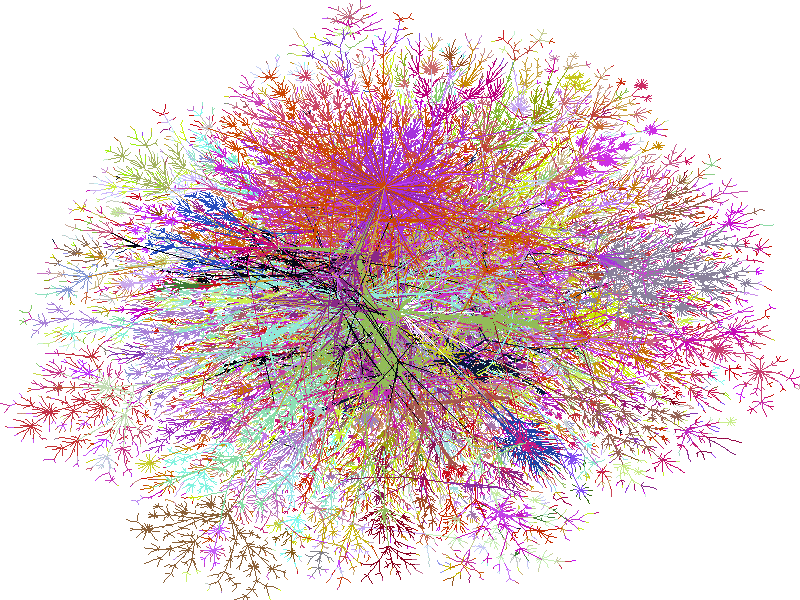
Instead of the internet being a broadcast medium, social media tools allow for one "media type" to easily transition to the next. Social media makes the internet look like this famous picture by Bill Cheswick:


Each of these branches is an internet connection. When you look at this plotted map, you can see that the internet is actually connected throughout, like a giant conversation.

Here is an example of how, using social media, a conversation is transformed from looking like the table to looking like the Cheswick photo (I apologize in advance if this whole thing looks and sounds like an elementary math word problem):

  • Dick sends an e-mail question about what to do on Friday night to Jane.
  • Jane responds that he doesn't know, and copies a handful of other friends (Sally, John, Steve) via e-mail in her response.
  • Sally "tweets" the question to her Twitter account where 15 other people respond to her message with suggestions.
  • John posts the question on his Facebook Page, where one of his friends sets up a Facebook Event Page, and sends formal invites and requests for suggestions on the "wall".
  • When everyone shows up at the decided upon location, people start taking pictures (and/or video) with cell phones, and tags them and loads them real time to the internet using services like YouTube, Vimeo or Flickr.
  • Dick finds the pictures and videos, and posts them for discussion the next week on his blog.

The internet, using the free tools available for social media, opens up a conversational pattern that can connect all forms of media seamlessly with very little skill needed. People have adopted new types of technology and it has made group action much easier.

So, why would any of this make me uneasy? Imagine for a moment that Dick and Jane weren't planning a Friday night out with friends, but instead were planning a meeting about professional liability issues (or medical devices, or office property ratings - whatever your association might represent)? Where will your association fit in with this new model? Will you be able to harness the energy they bring to the table? Will you continue to be relevant as information becomes more and more transparent?

This is the link to the full Clay Shirky presentation:

http://www.fusionproductions.com/digitalnow/09-upload/Video/DN09-openingkeynote.wmv

I'd love to hear how your association is positioning itself to fit within this new media model.

Thursday, April 16, 2009

New computers

Back at it. We all have new computers. As usual we learned a few things about why not to name your hard drive with a persons name. It's hard to get rid of it once it's set. We learned again, about the importance of keeping track of passwords and serial numbers of all kinds of stuff. We learned that the cords for keyboards and the mouse have gotten much shorter and we needed to buy cord extensions. We learned that some of our ethernet cords were not long enough. And we learned that our old back up system wouldn't work with our new computers. Enough learning - already! Of course, we also learned that things just don't work exactly the same. But it's done - and we are on to the next project, a new data base. All in the name of serving our members more efficiently and effectively. It's a good thing.

Thursday, April 2, 2009

Bag Lady

It's official. I have become a bag lady. Others seem to be able to function with no added baggage. They leave their houses in the morning with their blackberrries or I-phones safely tucked into a pocket, or a purse. Today I left my house with 6 bags - My purse, my work-out bag, my laptop, my bag full of Rotary materials, my briefcase, and a bag to be delivered to my Mom @ the nursing home. Something is going to have to give. I hope it's not my back.

Wednesday, April 1, 2009

New computers

Crazy how things get away from you isn't it? We used to replace a computer every year. That way we were just looking at the price of one new system each fiscal year. But, everything was working fine, the systems were set, the money was spent on other needed items - and now our newest computer is 5 years old. And so it's time. We need new and we need them now. And so here we go on this whirl-wind journey of transferring the data, updating the software, and organizing the passwords. Words of wisdom to self: It will all work out eventually. Be patient. It will take some time. Get organized.